AI is everywhere in data quality conversations. LLMs are supposed to profile data, detect anomalies, suggest rules, and even automatically fix records. It sounds like the solution to a problem that has plagued data engineering teams for years. But there is a catch: AI does not understand your business. It sees patterns, correlations, and deviations. It does not see that “status = grace_period” was just changed by the product team and that the old definition of “active user” no longer applies. It does not see that a column that looks empty is empty because of a change in the source system, not because of a data error.
This article shows where AI genuinely helps in data quality, and where its effectiveness ends. And why the biggest risk is not that AI does not work, but that the team stops understanding what it is actually monitoring.
Table of Contents
What AI can actually do in data quality?
There is no point starting with limitations when AI delivers real value in several areas. DQOps lists concrete use cases where ML models and LLMs genuinely reduce work and improve detection: profiling hundreds of tables to find issues, monitoring data over time to detect drifts and anomalies, intelligent search for trustworthy datasets, and assisting in data cleansing by generating enrichment code or correcting data with LLM models.
These use cases share one characteristic: repetitiveness. Profiling 200 tables is work nobody wants to do manually. Monitoring 50 metrics day after day is a task AI performs without fatigue. Detecting a deviation that looks like noise but is not is something models handle better than the human eye on a dashboard.
DQOps also supports using AI to suggest thresholds and detect anomalies in data. Data observability tools capture historical values for each metric and use AI to suggest appropriate threshold values, which reduces the number of manually configured rules . This shows that AI is treated as an assisting tool, not a replacement for existing mechanisms.
Where AI fails: the boundary between pattern and understanding
The problem with AI in data quality is not that models are weak. It is that data quality issues are rarely purely statistical. Many problems stem from assumptions that are not written in the data, but in people’s heads.
A real-world example: the product team changes the definition of “active user.” Previously, active meant having a subscription with status = ‘active’. Now active also includes users in grace_period and trial states. An AI model monitoring the status column will not detect the problem, because the data still looks correct. Values match the type, there are no nulls, no duplicates. The problem only appears when a downstream model still uses the old definition and classifies grace_period users as inactive.
This is not a problem AI will solve, because AI does not have access to organizational context. It can detect that the distribution of values in the status column has changed. But it does not know whether that change is an error or a deliberate business decision. And without that knowledge, every alert is either a false alarm or a miss.
The risk nobody talks about: AI as a source of false confidence
There is another, less obvious problem than model limitations. When a team implements AI for monitoring, there is a temptation to trust it more than their own understanding of the data. “If the model says the data is good, then it must be good.”
This is a dangerous assumption. AI will not fix data it does not understand. Worse, it can make the problem remain invisible until it shows up in a board report. In the context of training data for LLMs, the problem is even more serious. If input data has defects, the model can “learn” bad patterns and make the problem even harder to detect. That is why profiling real data before starting model work is as important as the modeling itself.
When AI helps and when it hurts: the practical boundary
The boundary is simple to describe, though hard to implement. AI helps with detecting patterns. It does not help with understanding causes.
Detecting patterns means: anomalies in value distribution, metric drift over time, unusual value combinations that deviate from historical norms. AI does this well, often better than manually configured thresholds.
Understanding causes means: why this pattern appeared, whether it is an error or a deliberate change, who should respond, and how to fix the source. This requires knowledge of business processes, which AI can at best support but not replace.
The practical rule is: use AI to generate hypotheses, not to make decisions. The model says “something changed in column X.” The human says “that is a change in the source system that is expected” or “that is an error that requires fixing.” AI narrows the search space. It does not close the investigation.
How to implement AI in data quality without losing control
This is not an argument against AI. It is an argument for implementing it consciously, with a clear division of responsibility.
Start with profiling, not automatic fixing. AI is best at detecting what is wrong before anyone decides how to fix it. Profiling hundreds of tables to find issues is a task where AI reduces work without the risk of introducing incorrect corrections .
Keep a human in the loop for remediation decisions. AI can suggest a correction. A human must approve it. This is not bureaucracy. It is a safeguard against a situation where the model “fixes” data that did not need fixing, or breaks something that was working.
Monitor model performance, not just data. If AI detects fewer issues than it did a month ago, it does not mean the data is better. It may mean the model has aged, the input data has changed, or the threshold was adjusted. Monitoring the model itself is as important as monitoring the data.
Do not remove understanding from the process. If the team stops understanding why a given check exists and what its result means, AI becomes a black box. And a black box in data quality is a recipe for false confidence.
Summary
AI will not fix your data. It will fix certain problems faster than a human, detect patterns a human would miss, and reduce repetitive work. But it will not replace understanding of business processes, explain why data looks the way it does, or decide what to do about a problem.
Data quality in the LLM era is not about handing control over to the model. It is about using the model where it is effective and keeping humans where understanding is needed. The boundary between these two areas is not fixed. But if the team does not know where it runs, AI will start hiding problems instead of helping.
Data quality best practices - a step-by-step guide to improve data quality
- Learn the best practices in starting and scaling data quality
- Learn how to find and manage data quality issues
What is the DQOps Data Quality Operations Center
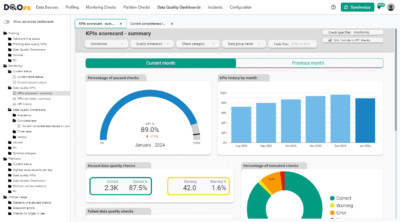
DQOps is a data quality and observability platform designed to monitor data and assess the data quality trust score with data quality KPIs. DQOps provides extensive support for configuring data quality checks, applying configuration by data quality policies, detecting anomalies, and automatically finding patterns using machine learning. DQOps supports over 150+ data quality checks, which cover all popular formats used in data conformance testing.
DQOps is a platform that combines the functionality of a data quality platform to perform the data quality assessment of data assets. It is also a complete data observability platform that can monitor data and measure data quality metrics at a table level to measure its health scores with data quality KPIs.
You can set up DQOps locally or in your on-premises environment to learn how DQOps can monitor data sources and ensure data quality within a data platform. Follow the DQOps documentation, go through the DQOps getting started guide to learn how to set up DQOps locally, and try it.
You may also be interested in our free eBook, “A step-by-step guide to improve data quality.” The eBook documents our proven process for managing data quality issues and ensuring a high level of data quality over time. This is a great resource to learn about data quality.