Data quality dimensions were supposed to be a shared language. Instead, they often become a source of misunderstanding. Business says “this data is outdated,” the engineer hears “timeliness.” Business says “customers are missing,” the engineer checks nulls_count on the customer_id column. Both are right, but they are talking about different things. And that is the source of most conflicts in data quality projects.
This article shows why business and engineers use the same words with different meanings, and how to build a shared language that does not require one side to learn the other’s vocabulary.
Table of Contents
Data quality dimensions: a shared framework, different interpretations
DQOps defines data quality dimensions as categories of data quality problems that are easy to understand and communicate. In the standard view, there are six core dimensions: accuracy, completeness, consistency, timeliness, validity, and uniqueness. Each answers a different question: is the data correct, is it complete, is it consistent across systems, is it current, does it have the correct format, is it unique.
The problem is not that the framework is bad. The problem is that business and engineers assign the same problems to different dimensions. For a business analyst, a sales report missing the last three days of data is “incomplete.” For an engineer, it is a timeliness problem, because the data is stale, not missing. Both descriptions are correct within their own definitions, but they lead to different checks and different responses.
Why this leads to conflict
Conflict appears when both sides have good intentions but different definitions. Business reports a problem: “customer data is outdated.” The data quality team runs a check on nulls_count in the email column and reports 98% completeness. Business looks at the report and says: “that’s not what I meant.”
What happened? Business was talking about timeliness: customer addresses in the CRM had not been updated for months, so the data is old, even if it is complete. The engineer checked completeness: are the fields filled in. Both dimensions are important, but the answer to one question does not answer the other.
The same mechanism works in reverse. The engineer reports that validity dropped because 5% of values in the phone_number column fail format validation. Business looks at it and says: “but I don’t use phone numbers in my reports anyway.” The problem is technically correct but business-irrelevant.
Dimensions are not a taxonomy, they are a point of view
The six core dimensions are just a starting point. In practice, there are many more categories of issues: schema drift, anomalies, table availability, PII detection, referential integrity. Each of these categories answers a different question and requires a different check.
But there is another, less obvious problem. Data quality dimensions are dependent on context of use. The same table can have high completeness and low timeliness for one consumer, and the reverse for another. An analyst building a predictive model on historical data needs completeness. An analyst monitoring current sales needs freshness. Both look at the same table and have different expectations.
Dimensions are therefore not an objective taxonomy of problems. They are a point of view on what matters. And the point of view depends on who is looking.
This is a dangerous assumption. AI will not fix data it does not understand. Worse, it can make the problem remain invisible until it shows up in a board report. In the context of training data for LLMs, the problem is even more serious. If input data has defects, the model can “learn” bad patterns and make the problem even harder to detect. That is why profiling real data before starting model work is as important as the modeling itself.
How to build a shared language without translating the vocabulary
The solution is not for business to learn the word “timeliness” and for engineers to learn to say “outdated.” The solution is to define the problem in terms of consequences, not categories.
Instead of saying: “we have a completeness problem,” say: “the sales report is missing 12% of transactions from the last week, which means the forecast for next month may be understated by about 8%.” This sentence contains the dimension (completeness), but expresses it through an effect that business understands.
Instead of saying: “timeliness dropped below the threshold,” say: “data in the orders table now has a 6-hour delay instead of 1 hour, which means the operational dashboard shows the state from 6 hours ago.” Again: the dimension is present, but it is not the starting point.
This shift in perspective has practical consequences for check configuration. DQOps lets you assign severity to checks, but severity should be defined by business impact, not by dimension category. A timeliness check on a table used once a month should not have the same priority as a completeness check on a table that feeds a daily board report.
A practical framework: four questions instead of six dimensions
Instead of starting the conversation with dimensions, start it with four questions both sides understand:
Is the data complete for the scope you need? This is a question about completeness, but expressed through consumer needs, not a technical definition.
Is the data fresh enough for your use case? This is a question about timeliness, but with a threshold defined by the consumer, not by a standard.
Are the values correct in the context in which you use them? This is a question about accuracy and validity, but without splitting them at the conversation level.
Is the data consistent with other sources you join it with? This is a question about consistency, but expressed through process, not category.
These questions do not replace dimensions. They are a communication layer between business and engineers. Dimensions remain in the background, as a way to organize checks in DQOps. But the conversation starts with needs, not with taxonomy.
Summary
Business and engineers will not agree as long as they talk about data quality dimensions instead of the consequences of problems. Dimensions are useful as a framework for organizing checks, but not as a language for communicating with business. The solution is not translating the vocabulary. It is changing the starting point: from “what is our completeness problem” to “what is missing from the report and what are the consequences.” Dimensions remain. But they stop being a source of conflict.
Data quality best practices - a step-by-step guide to improve data quality
- Learn the best practices in starting and scaling data quality
- Learn how to find and manage data quality issues
What is the DQOps Data Quality Operations Center
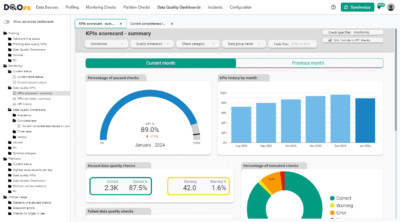
DQOps is a data quality and observability platform designed to monitor data and assess the data quality trust score with data quality KPIs. DQOps provides extensive support for configuring data quality checks, applying configuration by data quality policies, detecting anomalies, and automatically finding patterns using machine learning. DQOps supports over 150+ data quality checks, which cover all popular formats used in data conformance testing.
DQOps is a platform that combines the functionality of a data quality platform to perform the data quality assessment of data assets. It is also a complete data observability platform that can monitor data and measure data quality metrics at a table level to measure its health scores with data quality KPIs.
You can set up DQOps locally or in your on-premises environment to learn how DQOps can monitor data sources and ensure data quality within a data platform. Follow the DQOps documentation, go through the DQOps getting started guide to learn how to set up DQOps locally, and try it.
You may also be interested in our free eBook, “A step-by-step guide to improve data quality.” The eBook documents our proven process for managing data quality issues and ensuring a high level of data quality over time. This is a great resource to learn about data quality.